Showing posts with label Writing Wednesdays. Show all posts

Thursday, November 12, 2015

Dakotafire - Empowering Youth

Hot of the presses!

Arlington Builds on its Relationships


Look for the print copy in your mail or postal box tomorrow! 


Digital copies and more info can be found at www.dakotafire.net .

Stop by the office to get a sneak peek....

Wednesday, October 21, 2015

Adding Steps


By: Steven Pressfield | Oct 21, 2015 01:54 amRead in browser »

This post goes out with thanks to Derick Tsai, who taught me a type of Resistance I had never thought of (or at least had never given a name to.)


Usain Bolt. Resistance is always strongest at the finish line.


Derick had been working for months on two big projects of his own. He was getting really close to the finish of both, when all of a sudden job offers started coming in. He was offered a teaching post. A movie wanted him to come on board. Two other plum positions opened up, begging him to join.

Guess what happened to his two big projects.

A month later Derick and I were talking. “I let ‘em both drop,” he said, cursing himself. “Then I realized what I was doing. I was adding steps between almost-finished and actually-finished.”

I thought, “Wow, that’s a new one. Adding steps. I love it.”

Isn’t it strange, too, how the universe steps in to screw us up? The rule of thumb for the finish of projects is, “Resistance is always strongest at the finish line.” Somehow that diabolical force can even produce job offers and “opportunities” at just the right time to knock us off course.

The more I thought about it, the more I realized that this type of thing happened to me too. Or I should say, “I let it happen.” I accepted a research position once that I had no interest in. I’ve signed up for movies that had nothing to do with my vision for myself. Right at the finish of Something Big of my own. Arrrgggh.

My first literary agent, many years ago, was a gentleman named Bart Fles. Bart was over ninety when he started representing me and very wise in the ways of the lit biz. He used to ask me, as I approached the end of a manuscript, “How close are you to finishing?”

“Close, Bart. I’m really close.”

“Close is good enough,” Bart would say. “Give it to me now.”

I didn’t appreciate it at the time, but now I see how wise Bart was. He knew from decades of representing crazy writers (and what writer is not crazy?) that, as they neared the finish line, they’d inevitably begin tweaking and retweaking, doodling and noodling, and, in Derick Tsai’s phrase, adding steps.

Delivering late could be fatal. That perfect editor that Bart had been priming for months … she might move to another job, acquire a book similar to ours, get married and take off on her honeymoon. Anything could happen. We could torpedo the whole submission.

How much better, Bart knew, to get a manuscript in to an editor (even if it wasn’t 100% perfect) on October 20, when the publishing business was still functioning, than on December 10th, when everyone in the business had mentally checked out for the Holidays.

To be clear, I’m not lobbying for turning in sloppy work. When we ship, we better ship a product that works. But there’s a big difference between pro-level and super-duper-perfect.

Perfect can wait.

Added steps can wait.

Take a lesson from Derick and don’t let Resistance trick you.

When you’re close, push hard and get it done.

Wednesday, October 14, 2015

Are You Ready For Mama?

By: Callie Oettinger | Oct 09, 2015 12:30 amRead in browser »


Luther and Bobby stole their cousin’s new lawnmower.

The plan: The cousin would file a claim. After he received the insurance money, they’d return the lawnmower to him. He’d split the money with them.


Johnny Hooker and Henry Gondorff made scamming look good. Credit: Movie poster for THE STING.


When their half-baked schemes weren’t landing them in jail, they were selling their plasma or sorting out other ways to make a dime.

Gaming the system was the one thing they came by honestly. Their parents had been working the disability arena their entire lives. They were raised as gamers. Mama had the mad scamming skills of Johnny Hooker and Henry Gondorff, but on the redneck, not-so-good-looking, side of the track.

Luther was my high school friend Molly’s boyfriend and I watched their games as a third wheel, not wanting to be there, but not wanting to bail on Molly—which ended up happening anyway. I went from being amused by Scheming and Stupid to being scared.

It was amusing when Molly’s dad asked Luther where he went to college.

Dad: Where’d you go to school, son?

Luther: Penn State.

The reality: Switch Penn State to State Penn—or State Penitentiary. It wasn’t a lie. It just wasn’t the Penn State Molly’s Dad had in mind.

Amusing stopped and Scared stepped in when a gun came out during a routine argument. Usually they just called Social Services or another agency on each other—or on one of their family members. Pissed off at Mama? Call Social Services on her. Pissed off at Bobby? Call the police for a disturbance.

Jail seems a safe bet for where they are now.

The other option is trolling.

Mama was a wicked woman. Hate ran thicker than blood through her veins. Molly used to say that when she died, they wouldn’t have to embalm her because her blood was already 190 proof.

I imagine her behind a keyboard, spewing shit at every person she despises.

I didn’t want anything to do with her then. Now… She comes to mind all the time.

Mama and her family of Stupid rise to the top when I’m facing trolls.


Mama don’t mess around. Credit: Screen shot from the film THE GOONIES.

I know that if I reply, Mama will head to the fridge for her box of wine, fill up her guzzler glass, and settle in for the long haul, a twinkle in her eye and a smile on her face in the seconds before she unleashes the Hell that is her mind.

If you’re on the other side of her screen, are you ready for Mama?

The thing about Mama is that she doesn’t mess with small fries (unless they get in her way). There’s gotta be a dollar involved.

If she doesn’t know your name, she’s not gonna bother. So if you’re still building your “thing”, consider yourself safe.

If your new book or film or whatever is about to launch, which puts you in the public eye, consider yourself forewarned.

The bigger you are, the bigger your target becomes.

Are you protected?

Having a lawyer on hand is healthy. On your own, though . . . Ignore Mama, which is the course we take at Black Irish Books. We don’t engage. Mama is hard to ignore. If you can get by her, great. If you engage . . . You’re going to end up a mess, even if all you’re doing is defending yourself.

Sometimes Ego comes in and wants to shut down the Trolls. I can tell you now that Mama will not be shut down. In an alternate universe the role of the Energizer Bunny would be played by her. She’ll keep going until her battery has died, her cord unplugged.

If Ego steps forward, remind him of the time it takes to respond to Mama. Remind him that Mama is a professional scammer. She’s not lazy, but instead of putting her powers toward good and obtaining what she’d like through a career, she’s focused on destruction. She WILL wear your down. She WILL suck your time until you have none left for what’s important. She WILL keep going until she sees you destroyed or gets what she wants (which are usually the same thing). She IS a vampire and WILL try to take your life.

Consider yourself warned. Arm yourself with a lawyer and a troll shield. Mama’s out there ready to destroy you.

Are you ready to ignore Mama?


http://www.stevenpressfield.com/2015/10/are-you-ready-for-mama/?mc_cid=95552ff2ed&mc_eid=23dedc879b

Wednesday, October 7, 2015

What's WYSIWYG? How Today's Online Editor Came to Be

Written by Carly Stec | @CarlyStec


WYSIWYG. No, this isn't another one of those newfangled acronyms the kids are using these days -- it's actually been around for quite some time.

"What You See Is What You Get," or WYSIWYG for short, refers to an HTML editor in which the content appears as it would when it's live.

In contrast to traditional editors, a WYSIWYG editor focuses on the end result, allowing you to get a clearer sense of what you're creating as you're creating it. In Adobe Dreamweaver to Google Web Designer to the HubSpot Marketing Platform, WYSIWYG editors are simplifying the way we produce content.

But did you ever stop to think about where they came from? Let's explore.
WYSI ... Wait, What?

Before it was used to describe the technology that enabled users to visualize what the end product would look like, WYSIWYG -- pronounced wiz-ee-wig -- was popularized by a newsletter titled WYSIWYG.

Published by Arlene and Jose Ramos, the WYSIWYG newsletter was created for the Pre-Press industry and was eventually sold to employees at the Stanford Research Institute after three years of publishing.

Today, it's become synonymous with web editing experience -- and more related terms have surfaced. From WYSIMOLWYG (what you see is more or less what you get) to WYSIAWYG (what you see is almost what you get), these variations are often used to describe the limitations of certain editors that lack true WYSIWYG functionality.
The History of the WYSIWYG Editor
Pre-World Wide Web

Before WYSIWYG editors were introduced in the 1970s, content creators had little control over the way their documents appeared. In order to customize content, typists were instructed to use "control codes" that represented the desired formatting. This meant that a function as simple as centering a paragraph was a manual process where the typists were forced to add extra spaces to create the proper format.

It was evident that systems needed to change, but who would be the one to do it?

After earning his M.S. in Engineering Mathematics & Statistics at the University of California, Berkeley under computer scientist Butler Lampson, Charles Simonyi was recruited to Xerox PARC in 1972. It was here that Simonyi and Lampson began developing the WYSIWYG editor, which they'd started to conceptualize while at Berkeley.

By 1974, the world's first WYSIWYG document preparation program, Bravo, became operational. Bravo was enabled by the first fully networked personal computer, the Xerox Alto, which wasdeveloped at Xerox PARC in 1972.


Xerox Alto (Image Credit: Wikipedia)

However, Xerox Alto was never publicly marketed, and upon realizing that the WYSIWYG program would only be used internally at Xerox PARC, Simonyi decided to seek out new opportunities. Interested in the concept of a company that solely focused on software, Simonyi joined Microsoft in 1981.

At Microsoft, Simonyi worked with software developer Richard Brodie to begin development ona WYSIWYG word processor called Multi-Tool Word -- which was later renamed Microsoft Word in 1983.

While Microsoft Word has grown to become arguably the most widely used word processing software, it wasn't the first of its kind. In fact, upon its release, several other tools were already dominating the marketing, including WordStar -- the first mature WYSIWYG word processor from MicroPro.


WordStar running on DOS (Source: Wikipedia)

It was evident that progress was being made to expand the market for WYSIWYG programs, but adoption was slow during the 1970s and early 1980s due immature graphics capabilities and bitmap displays. However, as home computers grew more sophisticated, WYSIWYG programs began to crop up more frequently.
WYSIWYGs in the World Wide Web

After the first website went live in 1991, it was time for developers to explore more advanced WYSIWYG HTML editors. The goal was to create an editing interface that made it easy for those who weren't well versed in HTML to build websites.

The first WYSIWYG HTML editor, WebMagic, was launched by Silicon Graphics in 1995. Aftersecuring $2.5 million in funding from Silicon Graphic's president and COO Tom Jermoluk, John McCrea set out to launch a product line for web authoring.

The only catch? The project's deadline was less than 80 days away.

With no time to spare, McCrea hit the ground running with the help of VP and General Manager of Visual Magic Divisions, Way Ting. Unwilling to start from scratch, McCrea and Ting managed to struck a deal with Amdahl -- a maker of IBM-compatible mainframe computers -- that brought them both workable code as well as developer David Koplas. From here, they assembled a small team who would work tirelessly on the project until it was ready for launch on January 25, 1995.

While WebMagic was the first of its kind, similar editors were quick to follow. By October of 1995 Vermeer Technologies -- which was acquired by Microsoft in 1996 -- released FrontPage. Serving as the first WYSIWYG HTML editor on Windows, FrontPage was a valuable asset for Microsoft during the company's "browser war" against Netscape. However after years of iteration, Microsoft announced that the program would be superseded by Microsoft SharePoint Designer and Microsoft Expression Web in 2006.

During this time period, many other WYSIWYG HTML editors came to market, includingDreamweaver. Released by Macromedia in 1997, Dreamweaver quickly became another powerful WYSIWYG HTML editor, creating a user-friendly environment for website development. By 2005, Macromedia was purchased by Adobe -- along with the rights to Dreamweaver. Since then, Adobe has maintained development on the software, which now exists amongst other powerful tools in Adobe's Creative Cloud.

Wednesday, September 30, 2015

All Storytelling is About Metaphor


WRITING WEDNESDAYS


By STEVEN PRESSFIELD | Published: SEPTEMBER 30, 2015

A boxer takes a haymaker to the jaw. He falls. He struggles to one knee as the ref stands over him, counting, ” … two, three, four … ” Watch the faces in the arena. They have become that fighter. He is living their life, their struggle.


You are that fighter


That’s metaphor. That’s art.

You, the artist, are that fighter. You enact via your struggle (and the struggle of the characters you create), the life drama of those who look on as you fight. When we speak of “finding our own voice,” we’re not talking about finding our petty, selfish voice, mewling and sniveling about our own selfish shit. The voice we’re seeking is much bigger. It’s noble. It’s generous. It’s universal. It does not inflict itself upon the reader for its own self-interested reasons. Instead it seduces, intoxicates and incorporates the reader into a tale told of the reader and for the reader.

Your protagonist is not you. Your protagonist is the reader. You are not telling your story for yourself. You’re telling it for her. You’re telling her life story. You’re expressing her pain, her longing, her struggle.

Can you be that artist? Can you become that boxer? Can you train yourself and discipline yourself and motivate yourself to be good enough to merit a fight in an arena, a contest that people will buy tickets to see? Have you got the speed, the strength, the mental toughness?

Are you that fighter?


http://www.stevenpressfield.com/2015/09/all-storytelling-is-about-metaphor/?mc_cid=968ac3a149&mc_eid=23dedc879b

Thursday, September 24, 2015

Giving Ourselves Some Props


By: Steven Pressfield | Sep 23, 2015 01:03 amRead in browser »

I missed out on the self-esteem movement. My day was about twenty years too early.


Serena at Wimbledon. "Good job, kid. You did it."

My generation was more like the Un-self-esteem movement. The Self-Disesteem Movement. We were constantly being told what bums and losers we were. Be a man! Suck it up! What’s wrong with you? Those were the child-rearing mantras that our parents, teachers, and coaches—the Greatest Generation—dished out to us. If you brought home a report card with straight A’s, the only question was, “Where are the A+s?”

Personal validation became a big issue with my peers and me. I’m not sure where this topic sits with Gen X or Y or the Millennials or the generations after. Maybe those waves are cool with themselves. I don’t know.

But for my era, this area is a problem. The tough love cited above is pretty much the soundtrack playing inside my generation’s heads.

Now add Resistance. We all know what those tapes sound like. Pretty soon we’ve got a whole symphony, or dys-symphony, of self-denigrating abuse running non-stop on a loop inside our skulls.

Stir in the next element of this toxic brew—the fact that you and I are artists and entrepreneurs, i.e., we’re on our own, with no supporting social structure to pat us on the back, tell us when we’ve done a good job, give us a raise or a promotion, etc.

Now add the final component: the reality that, no matter how great a job we do at whatever we’re pursuing, there’s every chance that when we expose it to the real-world marketplace, it’ll fall on its face. Our screenplay will not be optioned, our novel will not be picked up (or worse, it’ll get published and sell 200 copies—199 to our immediate family), our app will fizzle and die.

Oh, I almost forgot the kicker. Our family and loved ones. It’s not that they don’t care or don’t understand. They’re just busy. They’ve got their own issues. And they’re a little pissed off at us, if you wanna know the truth, for spending so much time on that stupid script/novel/app instead of bringing home some real rent money. And by the way we haven’t been spending nearly enough time nurturing and caring for them and supportingtheir dreams.

These are First World problems, I know. They’re not like getting your entire city blown off the map in Syria. But they’re real, just the same.

This is the world we live in.

So what’s the antidote to this relentless tide of rejection, isolation, negativity and disdain?

Self-validation.

Self-acknowledgment.

It sounds crazy, I know. What are we supposed to do—lock the door to the bathroom, stand in front of the mirror and tell ourselves we’re doing great?

Well, in fact … yeah.

Did you watch the women’s final at Wimbledon a few weeks ago? One thing I always wonder: what does Serena do when she gets back to the house she’s renting for the fortnight? When it’s late and the reporters are gone and her family and friends have slipped off to bed. Is there a moment when she sits alone with that golden Rosewater dish (the trophy for the ladies’ singles champion) and says to herself, “Good job, kid. You did it.”

Of course your world and mine is not as palmy as Serena Williams’. She’s got external validation coming in from everywhere. Trophies, checks, bonuses, sponsorship deals, her picture on TV and the covers of magazines.

You and I may get lucky. Once in a while, we may hit the jackpot. But over the course of a long career, the bottom line is this:


What the world does for Serena, we have to do for ourselves.

We have to self-acknowledge.

We have to self-validate.

(And actually Serena has to self-validate too.)

Who else is gonna do it?

Dumb as it sounds, we have to say to ourselves (and really make it sink in): “Okay, maybe we didn’t hit the best-seller list this time. Maybe we didn’t crack the top 10,000 on Amazon. But we did what we set out to do. We finished. We shipped. Yeah, our stuff could’ve been better. But we learned. We’re still standing. We got better. Good job, kid. You did it.”

Another critical aspect of validation:

Give it to others.

Show it to your homies. Kick it to your rivals. Give ’em some props when they hung tough, when they showed class, when they bit the bullet.

Full many a flower may be born to blush unseen, but that doesn’t mean you and I can’t see and appreciate them—and can’t single them out for praise. And it doesn’t mean we can’t see ourselves when we’re that flower.

There’s a term for this type of behavior.

It’s called mental toughness.

It describes those silent internal actions and habits, the ones that nobody sees but us, that no one knows about but us.

You won’t see these moments portrayed in movies. They’re not cinematic. They’re not heroic.

Even the people who perform them won’t talk about them. It’s unseemly. To admit to such actions seems silly, even a little shameful.

But these private actions and habits are make-or-break. They’re the difference between success and failure, between being a pro and being an amateur, between hanging in and dropping out.

I think back to my Mom and Dad, whose worldview was shaped by Depression and war. Maybe they were smarter than I thought, when they withheld easy praise and set standards for me that were higher than I believed I could achieve.

Whose opinion counts most in the end?

Who’s the one person we can’t fool?

Who really knows how deep we dug or how true we played it?

http://www.stevenpressfield.com/2015/09/giving-ourselves-some-props/?mc_cid=1f1f17397c&mc_eid=23dedc879b


Wednesday, September 23, 2015

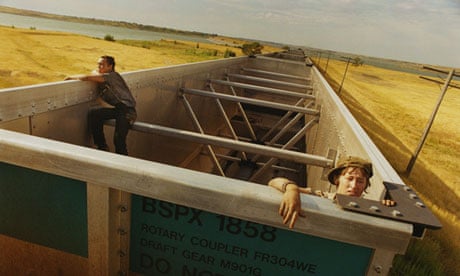
Riding the rails: Mike Brodie’s romantic Polaroids of freight-train life

A girl covered in grazes, battered baby boots, and a handmade wooden cross with the word ‘SON’ written on it … the Polaroid Kid’s haunting images of freighthoppers walk the line between pure tenderness and true grit
Born to run: portraits of American wanderers – in pictures
Suzanne, an image from the new book Tones of Dirt and Bone. All photographs: Mike Brodie/Twin Palms. Click to view full image


Sean O'Hagan

Thursday 26 March 2015 10.51 EDTLast modified on Thursday 26 March 201510.54 EDT

Mike Brodie came to public attention in 2004 after he started posting pictures online under the alias the Polaroid Kid. Back then, his story seemed too good to be true: a drifter with a Polaroid camera who captured the itinerant lives of the photogenic young people he met as he rode freight trains across the US.

Those early shots of kids who looked like hipster hobos were unashamedly romantic, and made all the more so by their soft Polaroid colours. Initially, Brodie shot on a Polaroid SX-70, given to him by a friend (the first picture he took was of his BMX bike). When the company stopped producing film, he switched to a Nikon F3, all the while creating homemade photobooks. “Brodie leapt into the life of picture-making as if he was the first to do it,” wrote the photographerDanny Lyon. “He was doing what he loved, and he did it compulsively.” Brodie’s Nikon pictures were published in his book A Period of Juvenile Prosperity, by the art-publishing house Twin Palms.
FacebookTwitterPinterest Corey Vinegar smoking in his tent

It all began in 2003 when, on a whim, Brodie dropped out of high school in Florida and rode a freight train to see how far it would take him. Only three days later, he was back home, but the lure of the hobo lifestyle kept calling. He rode the rails illegally, off and on, for the next five years. “A lot of the kids I knew have since gone back to their old lives,” he told me in 2013. “It was something they did, for whatever reason, before they settled down. Some were running away, some were out for adventure. It’s like being homeless by choice.”

Brodie acknowledges the issue of whether this kind of subject matter should be repackaged in expensive artbook form or hung on gallery walls. “You have two worlds colliding right there,” he said. Most of his subjects, he had said, were happy the photos were finding an audience.
FacebookTwitterPinterest Hayes and baby boot


Mike Brodie's freight-train photographs: 'It's a romantic life, at least in the spring and summer'

Read more

Two worlds also collide in his new book, Tones of Dirt and Bone, featuring photographs – many of which are Polaroids – taken between 2004 and 2006. They seem more considered, more artfully poetic even, than those in his previous collection. Brodie has an unerring eye for haunting landscapes and even more haunting – sometimes haunted – faces. A girl in a fur hat stares sideways at his camera, her grazed face and chapped lips suggesting a hard life lived at considerable cost. On the opposite page, though, a boy with long hair in a peaked cap and hippy threads could easily come from the cover of an album by Devendra Banhart. Brodie’s Polaroid romanticism is his great strength, but you wonder if it sometimes conceals more than it illuminates about the hard lives of his subjects. His photos walk the line between pure tenderness and true grit, and one cannot help sensing that there is a degree of mythologising at work.

But there is much to admire. Self-taught and naturally talented, Brodie often homes in on telling details: an adolescent neck dappled with love bites; a child’s small battered boot tucked between the even more battered boots of a parent; alone wooden cross, strewn with flowers and soft toys, with the word “SON” handwritten on it. These are the fragments he has gathered in his itinerant existence, each one a signifier of a community beyond the realms of traditional society.
FacebookTwitterPinterest Hickeys on my neck

There is a melancholy undertow to his best pictures – a sense of loss, and a sense of lives surrendered to drift, survival and danger. The objects and landscapes he photographed all carry a similar sense of mystery: a bunch of leafy flowers, or a dead bird held in an outstretched hand; a railway track or a wintery road disappearing into the horizon. Everything is bathed in the soft, nostalgic tones that made Polaroid film such an evocative medium.

These days, Mike Brodie has settled down. He lives with his wife, Celeste, in California, where he works as a mechanic. In Tones of Dirt and Bone, he wrote: “The photos? I want people to see them just as I want to tell someone a good story … And when I’m dead, maybe my lungs will still be around, with some words beneath: ‘Everything comes as a surprise – thank God.’”

Wednesday, June 3, 2015

How to Create a Compelling Business Case Study: The Ultimate Guide & Template

Written by Carly Stec | @


Case_Study_Edit.jpeg
Struggling to earn the trust of potential new customers?
Before you can expect them to open up their wallets, you need to start the sales process by demonstrating your ability to deliver on what your product or service promises. 
Sure, you could tell them that you're great at X and that you're light-years ahead of the competition when it comes to Y and Z, but at the end of that day, that's just lip service. What you really need to win new business is cold, hard proof. 
One of the best ways to prove your worth is through the creation of compelling case studies that chronicle the positive impact your product or service has had on one of your existing customers. To help you arm your prospects with information they can trust, we've put together a step-by-step guide on how to create effective case studies for your business -- as well as a free template for creating case studies of your own. 

How to Write a Case Study: The Ultimate Guide 

How to Find the Right Case Study Candidate

In order to provide your sales team with truly valuable case studies, you need to have a definitive plan for selecting the most qualified candidates. Here's what you should look for in a potential case study candidate:
  • Product Knowledge: The more well-versed a customer is in the logistics of your product or service the better. This will help to ensure that they can speak to the value of what you offer in a way that makes sense for future customers. 
  • Exemplary Results: The companies that have seen the best results are going to make the strongest case studies. Not to mention, if you've done really well for them, it's likely that they'll have the enthusiasm you're looking for. 
  • Unexpected Success: Non-traditional customers that have seen positive results can help absolve any doubts potential customers may have.
  • Recognizable Names: While small companies can have powerful stories, bigger or more notable brands can help increase credibility. 
  • Switchers: Customers that came to you after working with a competitor help highlight your competitive advantage and sway decisions in your favor.

Read the complete Article at: http://blog.hubspot.com/blog/tabid/6307/bid/33282/The-Ultimate-Guide-to-Creating-Compelling-Case-Studies.aspx?utm_campaign=blog-rss-emails&utm_source=hs_email&utm_medium=email&utm_content=17980732

How to Ensure You're Asking the Right Questions

When it comes time to execute on the questionnaire and actual interview, you want to be sure that you're setting yourself up for success. In order to end up with a strong use case, it's important that you're prepared to not only ask questions, but also ask the right questions. 
In terms of the questionnaire, here are a few sample questions to get you started:
  • What are your goals?
  • What challenges were you experiencing prior to purchasing our product or service?
  • What made our product or service stand out against our competitors?
  • What did your decision-making process look like?
  • How have you benefited from using our product or service? (Ask for specific numbers if applicable.)
Keep in mind that the questionnaire is designed to help you turn up the insight you need to ask strong, success-focused questions during the actual interview. 
As for the phone interview, we recommend that you follow the "Golden Rule of Interviewing."
Sounds fancy, right?
It's actually quite simple: Ask open-ended questions. 
If you're looking to craft a compelling story, yes or no answers are going to get you nowhere. It's critical to maintain a focus on questions that invite elaboration such as "can you describe ..." or "tell me about ..."
In terms of a structure for the interview, we recommend breaking down the process into six specific sections -- The Customer's Business, The Need for a Solution, The Decision Process, The Implementation, The Solution in Action, and The Results. These focus areas allow us to gather enough information to put together a rich, comprehensive study. 
Here's a deeper dive into what these sections look like:
  • The Customer's Business: The goal of this section is to generate a better understanding of the company's current challenges and goals, and how they fit into the landscape of their industry. 
    • Sample questions: How long have you been in business? How many employees do you have? What are some of the objectives of your department at this time? 
  • The Need for a Solution: In order to tell a compelling story, you need context. This helps match the customer's need with your solution. 
    • Sample questions: What challenges and objectives led you to look for a solution? What would have happened if you did not identify a solution? Did you explore other solutions prior to this that did not work out? If so, what happened?
  • The Decision Process: Exploring how the customer arrived at their decision to work with you helps to guide the decision-making process of potential customers. 
    • Sample questions: How did you hear about our product or service? Who was involved in the selection process? What was most important to you when evaluating your options?
  • The Implementation: Your focus should be on exploring their experience during the onboarding process. 
    • Sample questions: How long did it take to get up and running? Did that meet your expectations? Who was involved in the process?
  • The Solution in Action: The goal of this section is to better understand how the customer is using your product or service. 
    • Sample questions: Is there a particular aspect of the product or service that you rely on most? Who is using the product or service?
  • The Results: This is where you want to uncover impressive measurable outcomes. The more numbers, the better. 
    • Sample questions: How is the product or service helping you save time and increase productivity? In what ways does this enhance your competitive advantage? How much have you increased metrics X, Y, and Z? 

How to Lay Out Your Case Study: Sample Case Study Format 

When it comes time to take all of the information you've collected and actually turn it into something, it's easy to feel overwhelmed.
Where should you start? What should you include? What's the best way to structure it?
To help you get a handle on the layout, we recommend focusing on building out the following seven sections: 
  1. Title: Keep it short. Focus on highlighting the most compelling accomplishment.
  2. Executive Summary: This should be a 2-4 sentence summary of the entire story. You'll want to follow it with 2-3 bullet points that display metrics showcasing success. 
  3. About: This serves as an introduction to the person or company and can be pulled from their LinkedIn profile or website.
  4. Challenges: This section should include 2-3 paragraphs describing the customer's challenges prior to using your product or service, as well as the goals that they set out to achieve.
  5. How You Helped: This section should include 2-3 paragraphs that focus on describing how your product or service provided a solution to their problem.
  6. Their Results: This section should include 2-3 paragraphs that prove how your product or service specifically impacted the person or company and helped them achieve their goals. Include numbers to quantify your contributions. 
  7. Supporting Visuals or Quotes: Pick one or two powerful quotes that you would feature at the bottom of sections above, as well as a visual that supports the story you are telling. 


Wednesday, April 1, 2015

Second Draft Thoughts

By: Steven Pressfield | Mar 25, 2015 01:52 am

Read in browser »


I’m writing this on Friday, March 23, having just read Shawn’s post from today, “The Second Draft (Is Not A Draft),” which I love and which I agree with 100%. I never see what Shawn or Callie write until it appears on the blog. I don’t show ‘em my stuff early either.


Olivier and friend in "Hamlet." Second drafts can scare the hell out of you.

Anyway I gotta chip in my two cents on the subject of second drafts.

I’m gonna say exactly what Shawn said, but using a different metaphor. Here goes:

To me, first drafts are like blitzkriegs. They’re like the Israeli army charging across the Sinai Peninsula in four days in 1967. Or our own First Marine Division rolling up to Baghdad from Kuwait in 2003.

The concept behind blitzkrieg is don’t look right, don’t look left, just keep charging forward. If you hit a place where the enemy is putting up strong resistance, don’t stop to slug it out with him. Go round his flank. Leave him where he is. Keep rolling forward.

The danger for the attacking force in such “wars of movement” is that those bypassed enemy forces will rise up and strike you. They may attack your exposed flanks or cut off your lines of supply. That’s the chance you take with blitzkrieg.

You’re betting that rapid movement and relentless forward momentum will carry your forces so deeply into enemy’s rear so fast that the foe will panic. Your advance will seem irresistible. It will acquire a perceived power greater than it actually possesses.

The other huge asset of a rapid forward thrust is that it fills your own troops with confidence. They own the initiative. They’re dictating the action. They’re acting, not reacting.

First drafts, to me, are like blitzkriegs. The aim is to get from PAGE ONE to THE END as fast as possible.

Why?

Resistance.

I don’t wanna give that bugger one milli-second to dig in or rally or counter-attack.

I want the enemy confused and reeling and I want my own guys brimming with confidence. Faster! Let’s roll!

And it works. I bypass all sticking points. I don’t stop to fight it out over a strategic bridge or crossroads. I find a way around and I keep going.

That’s Draft #1.

Get to the Suez Canal.

Get to Baghdad.

Ah, but what happens once we’ve reaching our objective?

We’ve seized the brass ring but we’ve still got a dozen enemy strong points behind us.

We have reached Draft Two. Exactly what Shawn was writing about in “The Second Draft (Is Not A Draft.)”

The second draft is going back and mopping up those hot spots and pockets of resistance.

In writing terms, what are those hot spots?

They’re story problems.

They’re the scene where Hamlet goes into a four-minute soliloquy about his indecision in picking the right necktie. The scene where Pierre and Natasha elope to Las Vegas.

Or they’re out-and-out holes in the story. No Hamlet indecision at all. No Pierre-Natasha romantic angst at all.

What Shawn means when he says second drafts are about using our left brain, our editor’s brain, and not our right/writer’s brain is that now we’re faced with concrete problems. Logic problems. Problems of architecture, of what we’ve put in that shouldn’t be in or what we’ve left out that has to be filled in.

As Shawn says, second drafts are not linear. We don’t go all the way back to Kuwait City and attack across the Iraq-Kuwait border again. Instead we go straight to the toughest pocket of resistance. Now we slug it out. Now we pay the piper that we didn’t pay before.

Second drafts are tough. The reason we bypassed those sticking points earlier is because they were hard. They presented problems that we didn’t want to face.

Now in Draft #2 we have to face them.

But here’s the good news (if you’ll forgive me for piling on with this military metaphor):

The good news is that the enemy troops who were so stoutly defending that bridge or crossroads before may have melted away in the interim. Who can blame them? They see our forces all the way north in Baghdad. The war is basically over. Why should they make some heroic stand here at the bridge at Nasiriyah when they’re just going to be surrounded and wiped out?

Same with story problems.

Since we’ve now written all five acts in Hamlet, it has become excruciating clear to us that the prince’s problem is indecision. Maybe that solo scene where the Melancholy Dane debates with himself about selecting the right necktie … maybe we should elevate the stakes a little. What if we put a dagger in his hand and had him turn the blade toward his own belly?

Second drafts are about going back and smoking out all those gremlins we bypassed in our headlong rush toward THE END.

This is left brain work. It’s dirty. It’s glamorless. And it’s absolutely necessary.

What was that word that Shawn used?

Oh yeah …

Editing.

http://www.stevenpressfield.com/2015/03/second-draft-thoughts/?mc_cid=9142884bab&mc_eid=028e6a9f2d

Wednesday, March 25, 2015

Writing a Thank You Note

communicatebetterblog.com


By Ali Hale
Writing a Business Thank you Note
Thank you notes are mandatory and expected in some situations. A recent survey by CareerBuilder.com found that:
  • Nearly 15 percent of hiring managers would reject a job candidate who neglected to send a thank you letter after the interview
  • 32 percent said they would still consider the thankless prospect but that their opinion of him or her would diminish
– advice from Write Express


As you can see, after a job interview, a thank you note may be a must. (This will depend on your career area and the business etiquette in your country.) And in any business situation, it never hurts to send a polite letter, whether or not you think it’s absolutely required.

A business thank you letter is somewhat different to the sort you send to your Grandma in gratitude for your Christmas slippers. Your business letter should:
Be typed, ideally on letter-headed paper. (Handwritten or emailed letters are okay if you know the recipient will prefer this.)
Be sent promptly (within 24 hours of an interview, for instance).
Be friendly but also professional. It would be very inappropriate to end a business thank you with “love from”.

Structuring a Business Thank You Note

As with the personal thank you note, there’s an easy formula to follow.
Set your letter out as a proper business letter, using letter headed paper and including your address, the recipient’s address, and the date. (You can find instructions on US business letter format and UK business letter format here on Daily Writing Tips.)
Address the recipient as “Dear [name],” erring on the side of caution regarding formality. (“Mr Jones” or “Dr Smith” rather than “Bob”).
Start by thanking them for the interview, pay rise, promotion, event, or other occasion that you’re writing about.
Go on to mention something specific about how it has helped you, or how you enjoyed the event. Be sincere, and make it clear how much you appreciate their time and effort.
You may want to mention the next occasion on which you hope to see them – though try not to be presumptuous. If you’re writing a thank you note for an initial interview, don’t act as though you’ve already been given the job!
End with “Yours sincerely” when writing to someone you don’t know well (an interviewer or acquaintance from another company). If you’re writing to your boss or manager, “Best wishes” or “Many thanks” might be an appropriate way to close your letter.

Example of a Business Thank You Note

There are some good examples at Business Thank You Note Samples, including this one:
Dear [City officials names],
We’d like to express our gratitude for the school administrators’ luncheon last week. The luncheon itself was very well done and enjoyed by all, but of course it’s the sentiment behind the gathering that means the most. The city’s renewed united commitment is a boost to the administration’s morale and a vote of confidence in the school’s future. For that, we thank you .
Best wishes,


As with a personal note, a business thank you letter needn’t be long. Indeed, since the recipient is likely to be busy, you should try to be concise and stick to the point. And make sure you double and triple proofread your letter – especially if it’s one you’ve sent after an interview, in the hopes of being hired. Early impressions really do count for a lot.


Read the full Article at: http://www.dailywritingtips.com/writing-a-thank-you-note/

Thursday, March 19, 2015

How to write a Great Business Plan


https://youtu.be/PDWvcsTloJo

Harvard Business Review
By William A. Sahlman
Few areas of business attract as much attention as new ventures, and few aspects of new-venture creation attract as much attention as the business plan. Countless books and articles in the popular press dissect the topic. A growing number of annual business-plan contests are springing up across the United States and, increasingly, in other countries. Both graduate and undergraduate schools devote entire courses to the subject. Indeed, judging by all the hoopla surrounding business plans, you would think that the only things standing between a would-be entrepreneur and spectacular success are glossy five-color charts, a bundle of meticulous-looking spreadsheets, and a decade of month-by-month financial projections.

Nothing could be further from the truth. In my experience with hundreds of entrepreneurial startups, business plans rank no higher than 2—on a scale from 1 to 10—as a predictor of a new venture’s success. And sometimes, in fact, the more elaborately crafted the document, the more likely the venture is to, well, flop, for lack of a more euphemistic word.

What’s wrong with most business plans? The answer is relatively straightforward. Most waste too much ink on numbers and devote too little to the information that really matters to intelligent investors. As every seasoned investor knows, financial projections for a new company—especially detailed, month-by-month projections that stretch out for more than a year—are an act of imagination. An entrepreneurial venture faces far too many unknowns to predict revenues, let alone profits. Moreover, few if any entrepreneurs correctly anticipate how much capital and time will be required to accomplish their objectives. Typically, they are wildly optimistic, padding their projections. Investors know about the padding effect and therefore discount the figures in business plans. These maneuvers create a vicious circle of inaccuracy that benefits no one.

Don’t misunderstand me: business plans should include some numbers. But those numbers should appear mainly in the form of a business model that shows the entrepreneurial team has thought through the key drivers of the venture’s success or failure. In manufacturing, such a driver might be the yield on a production process; in magazine publishing, the anticipated renewal rate; or in software, the impact of using various distribution channels. The model should also address the break-even issue: At what level of sales does the business begin to make a profit? And even more important, When does cash flow turn positive? Without a doubt, these questions deserve a few pages in any business plan. Near the back.

What goes at the front? What information does a good business plan contain?

If you want to speak the language of investors—and also make sure you have asked yourself the right questions before setting out on the most daunting journey of a businessperson’s career—I recommend basing your business plan on the framework that follows. It does not provide the kind of “winning” formula touted by some current how-to books and software programs for entrepreneurs. Nor is it a guide to brain surgery. Rather, the framework systematically assesses the four interdependent factors critical to every new venture:

The People. The men and women starting and running the venture, as well as the outside parties providing key services or important resources for it, such as its lawyers, accountants, and suppliers.

The Opportunity. A profile of the business itself—what it will sell and to whom, whether the business can grow and how fast, what its economics are, who and what stand in the way of success.

The Context. The big picture—the regulatory environment, interest rates, demographic trends, inflation, and the like—basically, factors that inevitably change but cannot be controlled by the entrepreneur.

Risk and Reward. An assessment of everything that can go wrong and right, and a discussion of how the entrepreneurial team can respond.
Business Plans: For Entrepreneurs Only?

The assumption behind the framework is that great businesses have attributes that are easy to identify but hard to assemble. They have an experienced, energetic managerial team from the top to the bottom. The team’s members have skills and experiences directly relevant to the opportunity they are pursuing. Ideally, they will have worked successfully together in the past. The opportunity has an attractive, sustainable business model; it is possible to create a competitive edge and defend it. Many options exist for expanding the scale and scope of the business, and these options are unique to the enterprise and its team. Value can be extracted from the business in a number of ways either through a positive harvest event—a sale—or by scaling down or liquidating. The context is favorable with respect to both the regulatory and the macro-economic environments. Risk is understood, and the team has considered ways to mitigate the impact of difficult events. In short, great businesses have the four parts of the framework completely covered. If only reality were so neat.


Wednesday, March 11, 2015

The First Page

[Steven Pressfield is talking about writing fiction but the rules apply to a business plan as well. The first page of a novel and the executive summary of a business plan determine how and if your audience bother to continue reading. You must connect with your audience, not only in fiction but especially in something as mundane as a business report, when all antecedent pages are cookie-cutter - you have only one page to create an emotional bond with your reader. The First Page.]

By STEVEN PRESSFIELD | Published: FEBRUARY 4, 2015

There’s a terrific book that I often recommend to young writers—The First Five Pagesby Noah Lukeman. Mr. Lukeman is a long-time agent, editor, and publisher. The thrust of his counsel is this:


You gotta come outa the blocks FAST

Most agents and editors make up their minds about submissions within the first five pages. If they spot a single amateur mistake (excess adjectives, “your” instead of “you’re,” “it’s” instead of “its”), your manuscript goes straight into the trash.

Grind on those first five pages, says Mr. Lukeman. Make certain they are flawless.

I agree completely of course. But I would go further. The make-or-break page, to my mind, is Page One. Even more critical: Paragraph One.


It was the best of times, it was the worst of times, it was the age of wisdom, it was the age of foolishness …

The first paragraph, the first sentence is do-or-die. It has to be more than just free of error. It has to kick ass.


All happy families resemble one another; each unhappy family is unhappy in its own way.

Those two opening sentences are from A Tale of Two Cities and Anna Karenina. I’ve abbreviated them to show that they still work, even when they’re cut off. A great opening can hook a reader in as few as three words.


Call me Ishmael.

Nor does a riveting opening have to be particularly literary, or display masterful erudition, or inform the reader that the hero of the tale has just woken up to discover that he has been turned overnight into a cockroach.


If you really want to hear about it, the first thing you’ll probably want to know is where I was born, and what my lousy childhood was like, and how my parents were occupied and all that before they had me, and all the David Copperfield kind of crap, but I don’t feel like going into it, if you want to know the truth.

I think of Page One as a battlefield or a stage for seduction. The contest is between the writer and the reader. The reader comes to our first page, our first paragraph with two conflicting bents of mind. On the one hand, she wants nothing more than to be swept away. She wants to fall in love with our narrative. We’re Mr. Tambourine Man; she wants to be taken for a trip upon our magic swirling ship.

That’s Bent #1 in the reader’s mind. The second bent is pure suspicion. “Who is this writer anyway? Why should I trust him? How do I know he’s any good?” Even readers who have read other books we’ve written and loved them … even those true-blue fans are skeptical. “Yeah, he did it before, but how do I know this latest one doesn’t fall flat on its face?”

We have to win that battle, you and I, and we have to win it fast. We have to complete this seduction by Paragraph One, and certainly no later that Paragraph Two. Attention spans are short these days and getting shorter. Before that first Kindle page has flipped over, we better have either established our bona fides with the reader or charmed her or hypnotized her or got her curiosity going.

Here’s one trick. Start at the very beginning of your book and read down till you get to a sentence, or a run of sentences, that possess genuine magic. Then look back at the sentences that precede them. Can these sentences be cut? Cut them!


The legend is that Maxwell Perkins convinced Ernest Hemingway to get rid of the first two chapters of The Sun Also Rises. Not sentences or paragraphs. Chapters. He cut them till he got to this, at the start of what was originally Chapter Three.


Robert Cohn was once middleweight boxing champion of Princeton. Do not think that I am very much impressed with that as a boxing title, but it meant a lot to Cohn. He cared nothing for boxing; in fact he disliked it. But he learned it painfully and thoroughly to counteract the feeling of inferiority and shyness he had felt on being treated as a Jew at Princeton. There was a certain inner comfort in knowing that he could knock down anyone who was snooty to him, although, being very shy and a thoroughly nice boy, he never fought except in the gym.

Never take the reader’s attention for granted. We have to earn it, you and I, and that ain’t easy. Is there a secret? None that I’ve found. We’ve got to keep striving for that magic, wherever and however we can find it.

What we want is for the reader to stop resisting, to set aside her skepticism and to embrace the tale we are about to tell her. We want her onboard willingly and with all her heart. She must trust us. She must believe us. She must surrender to us.

If you can do that in the first paragraph or the first page, there’s a good chance she’ll hang on for the whole E-ticket ride.

http://www.stevenpressfield.com/2015/02/the-first-page/?mc_cid=4007ec8b20&mc_eid=028e6a9f2d


Wednesday, March 4, 2015

Killer Scenes, Part Three

[Writing a Marketing or Business Plan is telling a story. Think of each section of the plan as a scene. Good scenes make a good story, a good story start with a single idea.]


By: Steven Pressfield | Feb 18, 2015 01:33 am

Read in browser »
I start this post with an apology. In it I’m gonna cite something from my own work. I hate it when writers do that. “Use Tolstoy, man, or Shakespeare! We want something good.”

Colin Farrell as Alexander in Oliver Stone's movie of the same name.
But I gotta do it because in this instance I don’t have to speculate as to what the writer was thinking: I actually know.
The theme of today’s post is a continuation of the previous two: Killer Scenes and how to build them out into the global narrative that they imply. In this case, I’m going to address not a scene, but just two sentences.
The question we’ll be asking is: When we as writers have only one scene, or even just a fragment of a scene, how can we extrapolate from that the entire work? How do we build out the complete book from that single kernel? What mode of thinking do we employ?
First, let’s start with the Muse. I believe categorically that scenes and lines that pop into our heads come from some cosmic source. You may disagree. But that’s my story and I’m sticking to it. So when some electrifying scene or fragment suddenly appears in my consciousness, I take it as a penny from heaven, a clue in a mystery, a strand of DNA in a scientific experiment. Embedded in that microcosm is the Global Enchilada.
One day about ten years ago, two sentences popped into my head.
I knew immediately that these were the first two sentences of a book. And I knew I loved the book. But I knew nothing else. I didn’t know who the speaker was, or what the story would be, where it was set, nothing. Here are the two sentences:
I have always been a soldier. I have known no other life.
I let these sit for a couple of weeks. From time to time during the day I’d come back to them, always asking myself, “Who’s the speaker? Who’s saying this? What does it mean? What’s the book that these sentences are the start of?”
I couldn’t get an answer. Either nothing came or what came didn’t ring a bell. Then one day, I can’t remember exactly how, I suddenly knew with certainty: the speaker was Alexander the Great.
I didn’t know anything about Alexander the Great. I had never studied him. He was certainly not a figure I was preoccupied with. Nor did I have any conception of how a story about him would resonate with modern readers, or if they would even care. Would a book about Alexander sell? Would anybody besides me be interested?
Okay. Back to extrapolating. What can we as writers say from our two sentences out of the blue?
For sure we’ve got one thing: the identity of our protagonist. And we can deduce from the sense of the sentences two other critical elements.
First, the story will be told in the first person by Alexander. It has to be because “I have always been a soldier” is him speaking. The sentence is in his voice.
The other Big Thing we know is that the story’s slant will be military. Why? Because he, Alexander, says so. “I have always been a solider. I have known no other life.”
This last point may seem so obvious as to be barely worth noting. But it’s not. It’s absolutely critical. The subject of Alexander, keep in mind, can be addressed from many, many angles—political, psychological, historical. Mary Renault’s The Persian Boy was a first-person account of Alexander’s life told by his eunuch lover, Bagoas. Her other renowned work on Alexander, Fire From Heaven, was centered in the conqueror’s early life and the psychodynamics of his family. Oxford historian Robin Lane Fox’s Alexander the Great, which served in part as the basis for Oliver Stone’s movie Alexander, was an all-inclusive historical biography, as was classical scholar Peter Green’s Alexander of Macedon.
Clearly our book is going to be none of those. But what will it be? From our initial two sentences we have, so far, three key narrative elements: we have our protagonist, we have our narrator, we have our point of view.
And we have a fourth Big Thing: the actual historical facts of the protagonist’s life. If the book is going to be about Alexander, and if he is going to tell us his story as seen through the lens of a soldier, then implicitly we’ve got a number of real events that we know must be in his narrative. And, just as important to us as writers, we have other events that we know will be left out. Family stuff, politics, philosophy: we can probably jettison them. War and conquest: these we’ll keep. Alexander fought at least three world-altering battles—the Granicus River, Issus, and Gaugamela. Clearly these must be in the story, not to mention Chaeronea, the battle of the Hydaspes River in India, and the assault across the Jaxartes in Afghanistan.
Remember my post a few weeks back, “The Clothesline Method?” If we string our line from Story Start to Story Finish and hang on it just three or four of these battles, we’ve got, in page-count terms, at least half of our book already. Not bad.
What about theme? Let’s dig a little deeper into those first two sentences.
I have always been a soldier. I have known no other life.
Embedded in this phrasing is the idea of destiny. “I have always …. ” “I have known no other … ” The sense in these sentences is of a fate or calling established at birth or even before. These twelve words have a momentum as well, like notes in a melody. Here are the sentences I followed them with, trying only to sustain the tune:
… All that I know [of warfare], I knew at thirteen and, truth to tell, at ten or younger. As a boy I instinctively understood the ground, the march, the occasion, and the elements … the drawing up of troops came as second nature to me: I simply looked; all showed itself clear. My father [Philip of Macedonia] was the greatest soldier of his day, perhaps the greatest ever. Yet when I was ten I informed him that I would excel him. By twenty-three I had done so.
The Greeks had a word: daimon. The Roman equivalent is the Latin word genius. Both refer to an inhering spirit—divine in origin, all-knowing yet itself unknowable—which appears, twinned with us from birth, and guides and inspires our passage throughout our lifetime. If there ever was an individual whose career embodied possession by a daimon or a genius, it was Alexander.
What was Alexander’s daimon? Ambition? Lust for conquest? The passion for ultimate ascendancy to the point, even, of being called a god?
Could this daimon be our antagonist? Is this the real force that Alexander fought against, more so than even the physical kings and armies he conquered?
If the answer is yes (and my instinct tells me that it is) then we can safely say that from just two sentences, twelve words, we have identified our protagonist, our narrator, our point of view, probably two hundred pages of story, our theme, and our villain—with a lot more, we hope, still to be unearthed. The goddess, we must admit, knows how to pack a lot of dynamite into a very small package.
We’ll continue this investigation in next week’s post.